
How to Search Criminal Dockets
Use Kansas Judicial Branch CaseSearch for a public Barton County District Court criminal docket. Select Barton as the location, choose Case Number or Party Name, and add criminal case type, status, filing dates, or judicial officer when a broad search needs focus. Citation Number and Case Cross Reference Number are also documented choices.
A public result may show fewer details than the courthouse terminal. If CaseSearch finds the case but omits an image, note the event date and document label. If no result appears, check spelling and older number formats, remove excess filters, confirm the right court, and ask whether the matter is municipal, sealed, confidential, or outside online coverage.
- Open CaseSearch and select Barton County.
- Choose case number, party name, or another targeted search type.
- Narrow by criminal case type, status, dates, or judicial officer.
- Open case details and Events, then View Document when available.
- Take the case number and event date to Suite 306 for certification or an omitted file.
Barton County Criminal Docket Fields in CaseSearch
The official Smart Search materials document the controls used to locate state criminal matters. The current CaseSearch interface may change labels, but these search concepts remain useful.
| Field | Use |
|---|---|
| Location | Narrow statewide results to Barton County. |
| Search type | Choose case number, party name, citation, cross-reference, attorney, or judicial officer. |
| Advanced filters | Limit by case type, status, filing dates, or officer. |
| Events | Read appearances, settings, motions, orders, and disposition in date order. |
CaseSearch replaced the former Public Access Portal in 2025. eFlex is the signed-in filing system, not a public criminal docket search.
Official Barton County Criminal Docket Navigation
An official Kansas government page illustrates the CaseSearch sequence: choose the search type, enter a case number, select the county, open Events, and choose View Document when the filing is publicly available. The official navigation example is useful for understanding the interface without exposing a private Barton case.
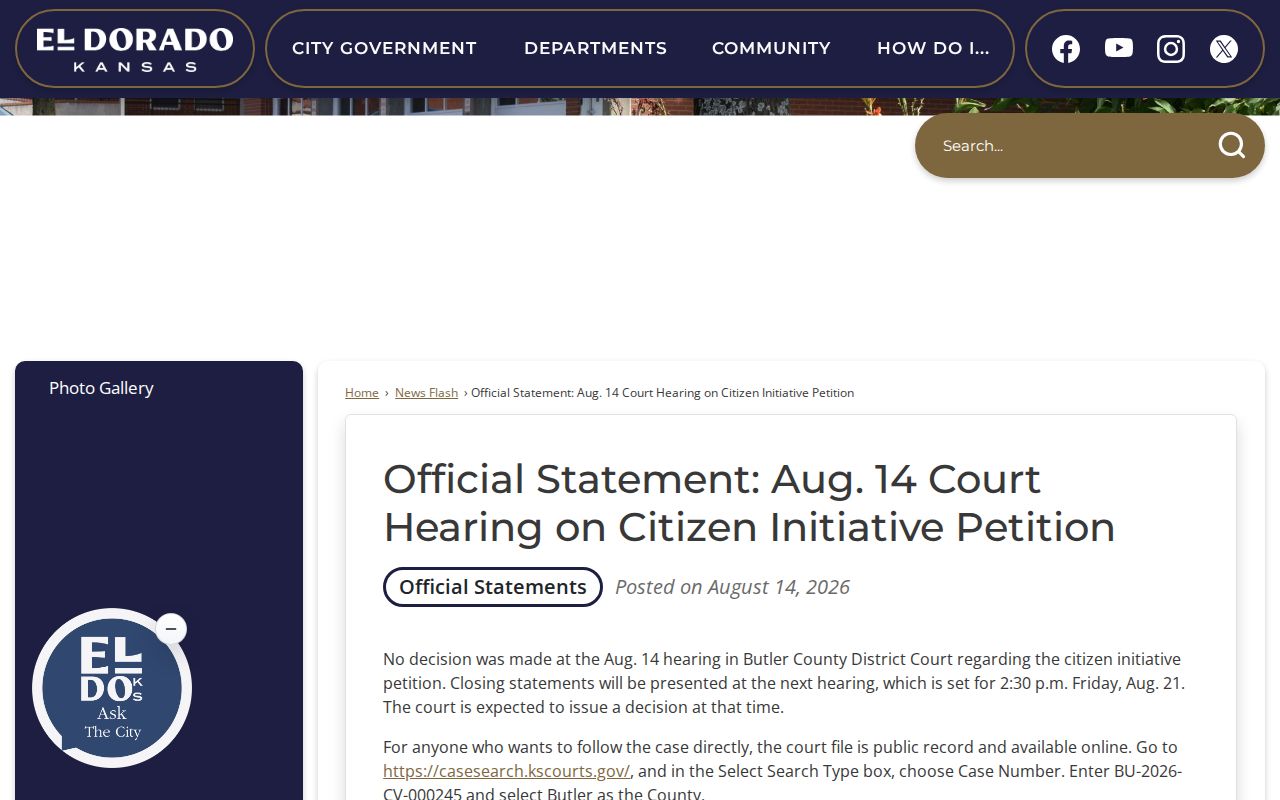
The image reinforces the distinction between the event register and document layer. A dated event can remain visible even when no downloadable image appears, so the clerk and courthouse terminal remain part of a complete access chain.
What a Criminal Docket Shows
A Barton County criminal docket is an event register rather than a police report or transcript. Its public header may identify the Barton/20th Judicial District location, case number, criminal case type, filing date, status, attorneys, and judicial officer. Events may record filing, appearance, arraignment, bond setting, motions, continuances, hearings, disposition, sentencing, and appeal.
| Case identity | Location, case number, type, filing date, and status. |
|---|---|
| Participants | Public case style, attorneys, and judicial officer. |
| Settings | Appearance, arraignment, motion, pretrial, hearing, or trial dates. |
| Filings | Public motions, orders, and judgments when an image is available. |
| Disposition | Plea, dismissal, diversion, trial result, judgment, or other recorded outcome. |
Barton County Criminal Motion Days
The 20th Judicial District local rules set criminal motion days on the second and fourth Fridays of each month. A motion-day entry is a setting, not a finding of guilt or a final result. Read forward for a later order, plea, dismissal, trial result, or sentence.
Local Rule 113 supplies the pattern, but an individual setting may move. Confirm the date in CaseSearch, the statewide next-seven-day hearings calendar, or with Suite 306. The calendar can show hearing time, case type, and presiding judge, but it is not the full docket.
Stages on a Criminal Docket
A common sequence begins with filing, then appearance or arraignment, pretrial work, plea or trial, disposition, and sentencing. Some stages are combined or skipped, and diversion creates another path. Read the actual dated entries instead of assuming that every case follows one route.
Docket flow: Filing › Arraignment › Pretrial › Plea or Trial › Disposition › Sentencing
Barton County Criminal Caseload in 2025
For the reporting period ending June 30, 2025, the official Barton row lists 278 felonies, 126 misdemeanors, and 7 appeals, for 411 criminal filings. The disposition report lists 274 felony dispositions and 137 misdemeanor dispositions. These are workload totals, not named records and not a result for any one case.
The Kansas Judicial Branch maintains the official case-statistics landing page used to locate the source reports.
The reporting tables provide county-level context, while CaseSearch remains the route for a public case. A disposition count is not a docket-entry count. One case can accumulate many events before an outcome appears, and the aggregate tables do not reveal a private party's history.
Which Court Holds Criminal Dockets
Barton County District Court holds state felony and state misdemeanor dockets. District magistrate judges are part of District Court and may handle assigned criminal stages. Great Bend, Hoisington, Ellinwood, Claflin, and Pawnee Rock municipal courts keep city ordinance and city misdemeanor dockets. An appeal from municipal judgment can reach Barton District Court under K.S.A. 22-3609.
The County Clerk is not the District Court criminal custodian, and sheriff reports are a different record series. Start with the court named on the citation or notice.
Barton County Criminal Files Beyond the Portal
Online event data and document images are separate layers. Kansas guidance says online documents generally begin when a court joined eCourt. An older public filing may exist even when no image appears. Record the case number, event date, and label before asking the clerk.
Clerk of the District Court
Martha Rivas
1400 Main Street, Suite 306
Great Bend, KS 67530
620-793-1856
Martha.Rivas@kscourts.gov
Ask for the Rule 22 terminal, a plain copy, or a certified copy. Barton does not publish a universal criminal-copy price, so request the exact fee and accepted payment method.
Barton County Criminal Docket Copies and Transcripts
A docket event, a filed document, and a transcript are not interchangeable. The event register can show that a preliminary hearing or other proceeding occurred. A filed order records the court's written action. A transcript is the separate written record prepared from the proceeding when available and properly requested.
Under the 20th Judicial District local rules, a request for a court reporter at a preliminary hearing must be made at least 48 hours before the hearing. The requester pays for transcript copies under the local rule. That deadline concerns creation of the hearing record, not public portal access. For an existing transcript, give Suite 306 the case number, hearing date, and exact item sought. Ask about availability, redactions, fee, delivery, and certification before paying.
A certified docket sheet bears the clerk's certification; an ordinary printout does not. Because Barton publishes no line-item schedule for these products, current cost must come from the clerk.
Reading Barton County Criminal Docket Events in Order
Event labels make sense as a sequence. A filing or opening event establishes the case. An appearance places a party before the court, while an arraignment records the formal charge-and-plea stage. A bond event concerns release terms or a related setting. A motion is a request for court action; it does not show how the judge ruled unless a later order or minute entry supplies the result. A continuance or reset changes a setting and should be followed by the replacement date.
- Arraignment
- The formal stage at which charges and a plea are addressed.
- Motion
- A party's request for a ruling, followed separately by an order or hearing result.
- Disposition
- The recorded outcome, such as dismissal, plea, diversion, trial result, or another final category.
- Sentencing
- The later event that records the court's sentence after a qualifying disposition.
A disposition and sentence can appear on different dates. Post-judgment motions and appeal notices can extend the register after the first outcome. When a label is unclear, compare its date with the entries before and after it, then request the public document tied to that event. Kansas does not publish a Barton-specific code dictionary, so avoid guessing at an abbreviation.
CaseSearch may also list a judicial officer, but the 20th Judicial District roster does not mean every listed judge handles every Barton case. Lisa Beran and Levi Morris are listed as District Judges at the Great Bend courthouse, while other district judges and magistrates sit in offices across the five-county district. The individual case record or clerk is the source for the assigned officer. A change in officer, courtroom, or setting should be confirmed before a courthouse trip.
Public Access and Sealed Criminal Dockets
Kansas Supreme Court Rule 22 separates internet portal access from the courthouse terminal. The terminal can show more otherwise-public index and event data than the internet, but neither access level opens a sealed or legally confidential record. Juvenile offender, child-in-need-of-care, expunged, grand-jury, adoption, and certain investigation material can be restricted. Public access also does not guarantee that every older filing has been scanned or that each public event carries a downloadable image.
Key Rules:
K.S.A. 38-2309 limits public access to juvenile-offender files.
K.S.A. 38-2209 protects child-in-need-of-care records.
A missing search result may also reflect a municipal case, older online coverage, spelling, or a sealing order.